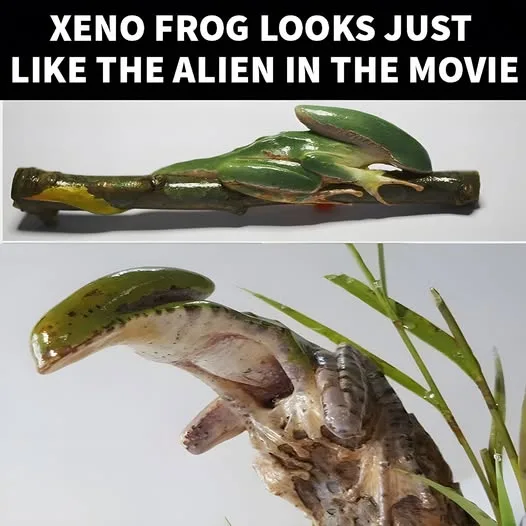
The “Xeno frog”—a nightmarish creature with elongated limbs, glossy black skin, razor-sharp claws, and a xenomorph-inspired head ridge—is not a mutant discovery or escaped lab experiment. It is a hyper-realistic sculpture created by Chinese artist Li Changchun in 2018. By masterfully blending the anatomy of a real frog with iconic traits from the xenomorph in Ridley Scott’s Alien franchise (1979), Li produced a piece so convincing that it fooled thousands online, sparking viral panic about a “new species” or genetic mutation. Shared widely on platforms like Reddit and Weibo, the sculpture’s lifelike details—down to textured skin, bulging eyes, and biomechanical ridges—blurred reality and fiction. As of December 21, 2025, it remains a testament to artistic skill and the internet’s love for the eerie.
The Artist: Li Changchun’s Mastery of the Macabre
Li Changchun, a Beijing-based sculptor known for hyper-realistic works blending biology and fantasy, crafted the Xeno frog as part of his “Bio-Mechanical Series.” Using silicone, resin, fiberglass, and hand-painted details, he achieved uncanny realism. The xenomorph influence—elongated skull, inner jaw, and predatory stance—fuses with frog anatomy: webbed feet, amphibian posture, and moist texture. Li’s process involves casting real animal specimens for accuracy, then modifying them with sci-fi elements.
The sculpture, about 50 cm long, was exhibited in Shanghai galleries and sold privately. Li has created similar hybrids, like biomechanical insects and avian predators, exploring themes of evolution, fear, and the unknown.
The Viral Panic: Mistaken for Reality
In 2018–2019, photos of the Xeno frog exploded online, often captioned as a “mutant frog from Chernobyl” or “alien hybrid discovered in China.” Forums debated its authenticity, with some claiming radiation or genetic engineering. Fact-checkers like Snopes debunked it, tracing to Li’s portfolio, but the myth persisted—paralleling hoaxes like the Fiji Mermaid or Merrylin Cryptid Museum.
The confusion stemmed from Li’s precision: reflective eyes, translucent skin veins, and posed dynamism made it indistinguishable from a preserved specimen. Like the De Loys ape or Eltanin Antenna, it shows how art can mimic nature convincingly.
Cultural and Artistic Significance
The Xeno frog taps into xenomorph lore—H.R. Giger’s biomechanical designs symbolizing primal fear. Li’s fusion with a frog (innocent, common) heightens horror, evoking body invasion themes from Alien. It critiques genetic modification fears and celebrates horror fandom, inspiring cosplay and fan art.
In China, Li’s work fits a trend of hyper-realism (e.g., Sun Yuan & Peng Yu), pushing boundaries between real and imagined.
Lessons for Today
The Xeno frog teaches:
- Art’s Power: Like the Moors’ Alhambra illusions, it blurs perception.
- Viral Misinformation: Echoing the third state’s cellular myths, it warns of quick judgments.
- Creativity’s Edge: Li’s blend, akin to dendrochronology’s precision, innovates boldly.
A Creature from the Studio
Li Changchun’s 2018 Xeno frog—a xenomorph-frog hybrid sculpture—fooled the internet into believing a monster was real. Like the black seadevil’s nightmare form or the white auroras’ ethereal glow, it captivates with crafted terror. Art that lives, breathes, and terrifies—proof that the scariest creatures are born from human imagination. 🐸👽