Imagine a single living being that quietly witnessed the birth of Islam, the signing of the Magna Carta, Columbus sailing to the New World, the American Declaration of Independence, and the U.S. Civil War — all without ever moving from its spot in a remote Sierra Nevada forest. That being was the Mark Twain Tree, a colossal giant sequoia (Sequoiadendron giganteum) that grew for 1,341 years before humans decided to cut it down in 1891.
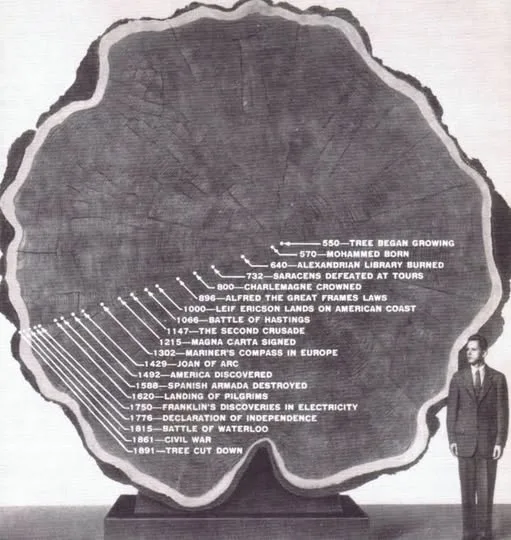
Its polished cross-section, with historical events carefully marked on the growth rings, remains one of the most powerful and humbling exhibits in natural history museums today. It turns abstract history into something tangible: a wooden calendar spanning centuries.
Here are some stunning views of these iconic sequoia cross-sections, complete with their labeled historical timelines:


The Giant That Became a Legend
The Mark Twain Tree stood in what is now Big Stump Grove in Kings Canyon National Park, California. Towering nearly 300–331 feet tall with a base diameter of about 16 feet (and a circumference approaching 52 feet at the ground), it was one of the most impressive specimens in its grove.
Despite the recent establishment of Sequoia National Park (1890) to protect these ancient giants, skepticism lingered. Many on the East Coast and in Europe dismissed tales of 300-foot trees as tall tales or hoaxes — echoes of the infamous “California Hoax” sequoia exhibits from the 1870s.
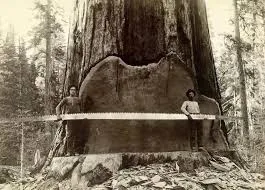
To prove the reality of these wonders, railroad magnate Collis P. Huntington funded the felling of the tree in 1891. A team of lumbermen spent 13 days laboriously sawing through the massive trunk with crosscut saws and axes. Sections were carefully prepared, transported by wagon and train, and shipped to major institutions: a basal cross-section to the American Museum of Natural History (AMNH) in New York, and a vertical slab (split into pieces for shipping) to what is now the Natural History Museum in London.
The AMNH display in the Hall of North American Forests still greets visitors with this enormous slice, a silent testament to nature’s scale.
A Timeline Carved in Annual Rings
Once polished and varnished, the cross-section became an educational masterpiece. Curators marked key events directly on the concentric growth rings — each ring representing one year of the tree’s life. Starting from the center (the oldest wood) and radiating outward:
- ~550 AD — The tiny seedling takes root in the Sierra Nevada wilderness.
- 570 — Birth of Muhammad.
- 732 — Saracens defeated at the Battle of Tours.
- 800 — Charlemagne crowned Holy Roman Emperor.
- 1000 — Leif Erikson reaches the North American coast.
- 1215 — Signing of the Magna Carta.
- 1492 — Columbus’s voyage to the Americas.
- 1588 — Defeat of the Spanish Armada.
- 1776 — Declaration of Independence.
- 1815 — Battle of Waterloo.
- 1861 — Start of the American Civil War.
- 1891 — The tree is felled.
In just over 13 centuries, humanity transitioned from the early medieval era through exploration, revolution, and industrialization — while this one tree simply kept growing, enduring fires, droughts, and storms.
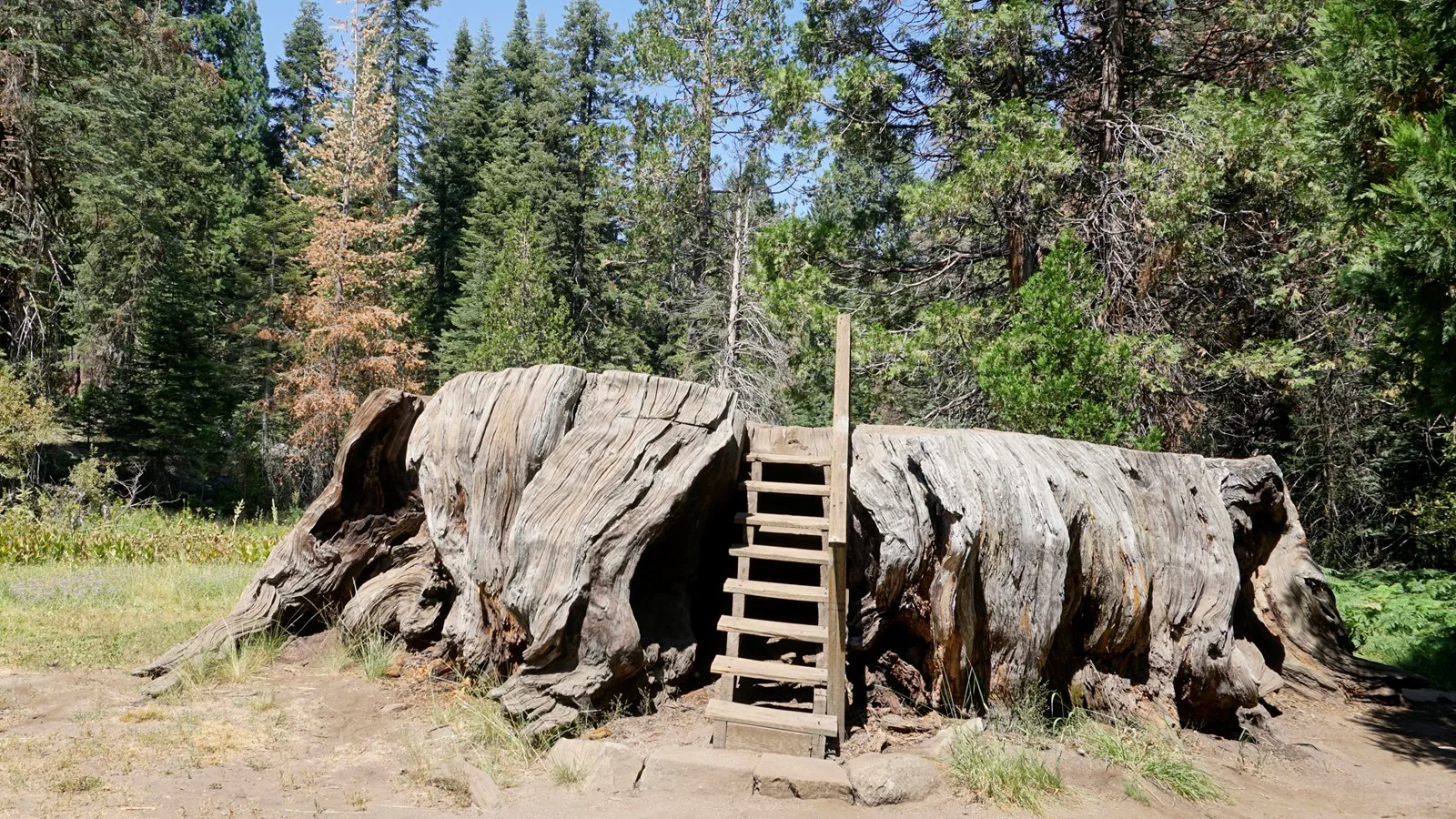
Here’s a closer look at the remaining stump in the park today — a quiet, weathered monument to what was sacrificed:
And the dramatic scene of loggers at the base after felling, axes in hand:

From Sacrifice to Symbol of Conservation
The felling of the Mark Twain Tree was bittersweet. It succeeded in convincing the world that giant sequoias were real — and magnificent — but at the cost of one irreplaceable ancient life. Public fascination with these displays helped fuel the broader conservation movement. Figures like John Muir and organizations such as the Sierra Club pushed for protection, leading to stronger safeguards for remaining groves.
Today, old-growth logging of sequoias is long banned, and living specimens can exceed 3,000 years (with the oldest reliably dated around 3,266 years). Yet these survivors now face modern threats: severe droughts, unprecedented wildfires intensified by climate change, and bark beetle outbreaks.
The Mark Twain Tree reminds us that deep time is real, and fragile. Human history may feel epic, but it occupies just a narrow band of rings on a single tree’s life. Standing before one of these exhibits — whether in New York, London, or images online — is a humbling experience.
Trace the rings with your eyes. Between Muhammad’s birth and the Civil War lies the entire arc of Western civilization’s formative centuries, all within the quiet lifespan of one being that asked only for sunlight, water, and centuries of peace.
What will the next 1,341 years bring? If we’re wise, the remaining giants will keep adding rings — bearing witness to whatever comes next.
Have you ever seen one of these sequoia cross-sections in person? Share your thoughts in the comments below!
🌲 Sources: American Museum of Natural History, Natural History Museum London, National Park Service records, and historical accounts of the Mark Twain Tree.