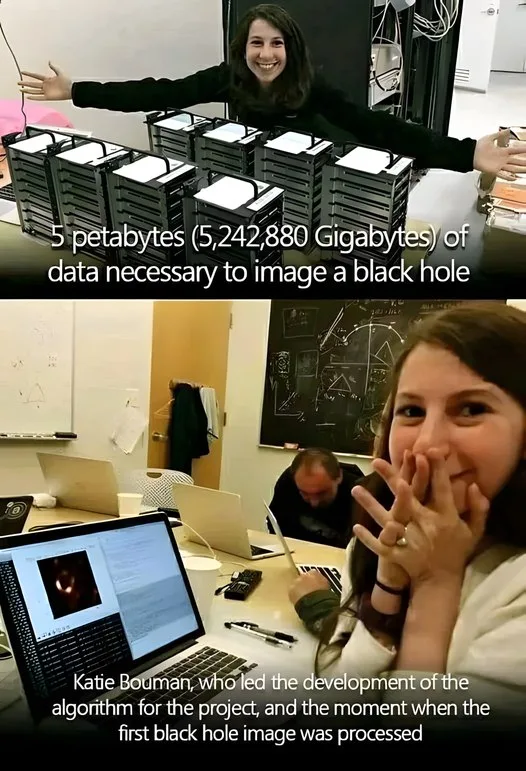
On April 10, 2019, the world witnessed a scientific milestone: the first-ever image of a black hole. At the center of this triumph stood Katie Bouman, a young computer scientist whose smile—captured in a viral photograph as the image loaded on her laptop—became an instant symbol of wonder, achievement, and the power of collaboration. Bouman, then a 29-year-old postdoctoral fellow at the Harvard-Smithsonian Center for Astrophysics, led the development of a crucial imaging algorithm for the Event Horizon Telescope (EHT) project, a global network of radio telescopes that captured the shadow of the supermassive black hole at the heart of galaxy M87. Processing 5 petabytes of data—the equivalent of 5 million gigabytes—the team reconstructed an image that confirmed Einstein’s general relativity and expanded our understanding of the universe. Bouman’s role, and the iconic moment of her reaction, highlighted not just the breakthrough, but the human joy behind one of humanity’s greatest scientific feats.
The Event Horizon Telescope: A Global Effort
The EHT is not a single telescope but a virtual Earth-sized array linking eight radio observatories across the globe—from Hawaii to the South Pole. Synchronized with atomic clocks, these telescopes observed M87’s black hole (55 million light-years away, 6.5 billion solar masses) in April 2017, collecting data on its event horizon—the point of no return.
The challenge: the data was too vast for real-time transmission. Hard drives were flown to central processing sites, yielding 5 petabytes—enough to store 5,000 years of HD video.
Katie Bouman’s Role: The Algorithm That Made It Possible
Bouman, with a PhD from MIT, developed CHIRP (Continuous High-resolution Image Reconstruction using Patch priors), one of three key algorithms used to synthesize the image from sparse, noisy data. CHIRP treated the problem like filling a crossword puzzle: using prior knowledge of black hole shapes (from simulations) to reconstruct gaps, while avoiding artifacts.
Her contribution was pivotal: without advanced imaging techniques, the raw data—full of interference—would remain incoherent. Bouman led a team testing algorithms blindly on synthetic data to ensure reliability. As she later said, “No one algorithm or person made this image; it required the talent of a global team.”
The Viral Moment: Joy in Discovery
The photograph—Bouman gasping with hand over mouth as the M87 image appeared on her screen—captured pure elation. Shared by MIT’s Computer Science & Artificial Intelligence Lab, it exploded online, amassing millions of likes and shares. It humanized science, inspiring women in STEM amid #WomenInSTEM trends.
Yet controversy followed: some falsely claimed Bouman took sole credit or that colleague Andrew Chael deserved more (Chael debunked this, crediting her leadership). The backlash highlighted gender bias in science, but Bouman’s grace—“This is the work of hundreds”—prevailed.
The Image: Confirming Einstein
Released simultaneously in six press conferences worldwide, the orange ring—photons bent by gravity around the shadow—matched general relativity predictions. M87*’s mass and spin were refined, advancing astrophysics.
Legacy and Impact
Bouman, now an assistant professor at Caltech, continues imaging research. The moment endures as a symbol of collaborative triumph, like the Moors’ Alhambra or the precision of dendrochronology.
The black hole image wasn’t just science—it was wonder made visible, with Katie Bouman’s smile its human face.