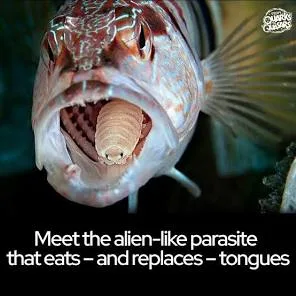
What you see in these pictures is a creature straight out of a science fiction nightmare—but it’s very real. Meet Cymothoa exigua, commonly known as the tongue-eating louse, a parasitic isopod crustacean that performs one of nature’s most astonishing and gruesome feats: it replaces a fish’s tongue with its own body. Discovered in 1826 by French zoologist Jean Louis Armand de Quatrefages, this parasite enters a fish through the gills, latches onto the tongue, severs its blood supply, and causes the organ to atrophy and fall off. The louse then attaches itself to the remaining stub, functioning as a living, working tongue while feeding on the host’s blood or mucus. Astonishingly, the fish often survives, using the parasite as a prosthetic organ. This is the only known case of a parasite functionally replacing a host organ. As of November 16, 2025, Cymothoa exigua remains a chilling example of evolutionary adaptation, showcasing the shocking strategies life has evolved for survival in the ocean’s depths.
Life Cycle and Parasitic Strategy
Cymothoa exigua belongs to the family Cymothoidae, parasitic isopods found in tropical and subtropical waters worldwide, from the Gulf of California to the eastern Atlantic. The life cycle begins when free-swimming juvenile males enter a fish—typically the spotted rose snapper (Lutjanus guttatus)—through the gills. Once inside, the juvenile transforms into a female (protandrous hermaphroditism) and migrates to the mouth. The female clamps onto the tongue with sharp claws, piercing blood vessels to drain nutrients. As the tongue necroses and detaches, the parasite secures itself to the tongue stub via seven pairs of hooked legs, effectively becoming a living replacement organ.
The host fish, surprisingly, adapts. It uses the parasite to manipulate food, with the louse feeding on blood or mucus without killing the host—a rare mutualistic parasitism. Males may later attach to the female for reproduction, with larvae released into the water to find new hosts. This cycle, documented in studies like Journal of Parasitology (2005), highlights an evolutionary masterpiece of deception and survival.
Ecological and Scientific Significance
Found in depths of 1–60 meters, Cymothoa exigua infects up to 10% of snapper populations in some regions, with no major impact on fisheries. Its discovery parallels the black seadevil’s rarity or the Eltanin Antenna’s mystery, challenging perceptions of parasitic limits. The parasite’s ability to replace an organ without fatal consequences offers insights into regenerative biology, akin to the third state’s cellular resilience or the lithopedion’s preservation.
Cultural and Historical Context
First described in the 19th century, Cymothoa exigua has fueled maritime lore, with fishermen calling it the “tongue biter.” Its gruesome nature evokes the Moors’ medical texts or the Dahomey Amazons’ strategic ingenuity, blending horror with fascination. Viral since the 2010s, it’s a staple in “weird nature” lists, alongside the caterpillar march or the De Loys ape hoax.
Lessons for Today
Cymothoa exigua teaches:
- Evolutionary Extremes: Like the Frydenbø generator’s adaptation, it shows survival through innovation.
- Biological Marvels: Its organ replacement, akin to dendrochronology’s precision, inspires medical research.
- Nature’s Balance: The fish’s survival, similar to Skilak Lake’s ecosystem, highlights symbiotic resilience.
A Living Nightmare
Cymothoa exigua, the tongue-eating louse, transforms a fish’s mouth into its home, replacing the organ it destroys. Like the precision of Hot Wheels or the mystery of the white auroras, it captivates with its alien biology. A parasite that becomes part of its host, it reminds us: nature’s most shocking creations are often its most ingenious.