The origins of the Museum Obscurum trace back to the life and obsessions of Rödder, born in 1821 in Nykøbing Falster into a wealthy German aristocratic family. Groomed for a conventional career in medicine, Rödder began his studies in Copenhagen, where he quickly distinguished himself in anatomy, pathology, and comparative physiology. Yet his notebooks from this period already hint at a restless mind—marginalia filled with sketches of nonhuman anatomies, speculative organs, and references to “unclassified life-forms.”
The Italian Encounter (1856)
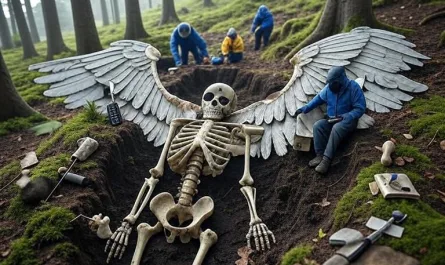
In 1856, while traveling through Italy on what was officially a medical study tour, Rödder encountered a series of strange writings and preserved specimens in a private collection near Naples. These artifacts—written in a hybrid of Latin, archaic Italian, and unknown glyphs—described beings that did not fit within any known taxonomic system. Preserved remains included wing fragments, anomalous dentition, and skeletal structures inconsistent with any recorded mammalian species.
It was through this encounter that Rödder was introduced to Thomas Merrylin, a London-based crypto-naturalist and xeno-archaeologist whose name circulated quietly among scholars interested in phenomena excluded from mainstream science. Merrylin’s work proposed that humanity existed alongside—or atop—a hidden evolutionary spectrum of sentient and semi-sentient species.
A Turn Toward the Occult Sciences
Under Merrylin’s influence, Rödder abandoned orthodox medicine and entered what he called scientia obscura—the study of forbidden, suppressed, or deliberately ignored life forms. His interests expanded beyond anatomy into folklore, viral mutation theory, esoteric anthropology, and pre-human evolutionary branches.
By the 1870s, Rödder had amassed an extraordinary private collection:
- Cryptozoological remains
- Preserved humanoid hybrids
- Alchemical instruments
- Field journals from dismissed anthropologists
- Specimens recovered from remote regions of Europe, Asia, and the Balkans
This collection would later be formalized as the Museum Obscurum, intended not as entertainment, but as evidence.
Homo lupus — The Werewolf
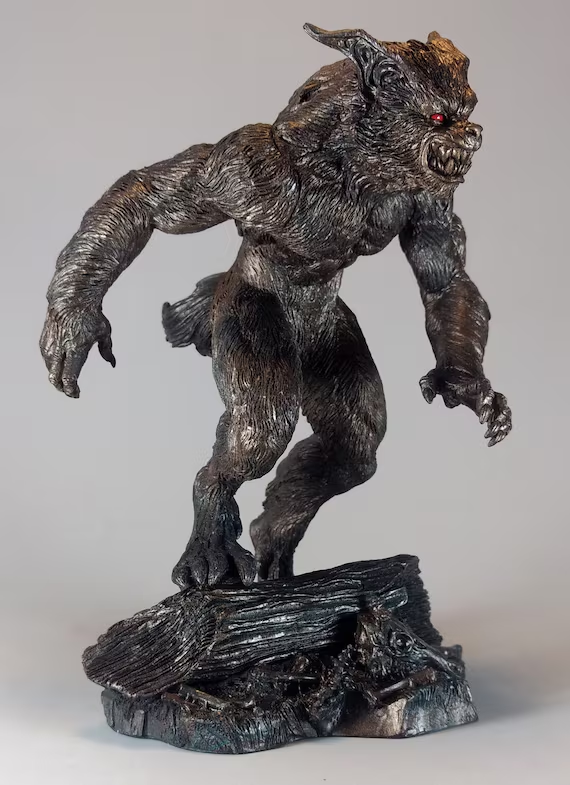
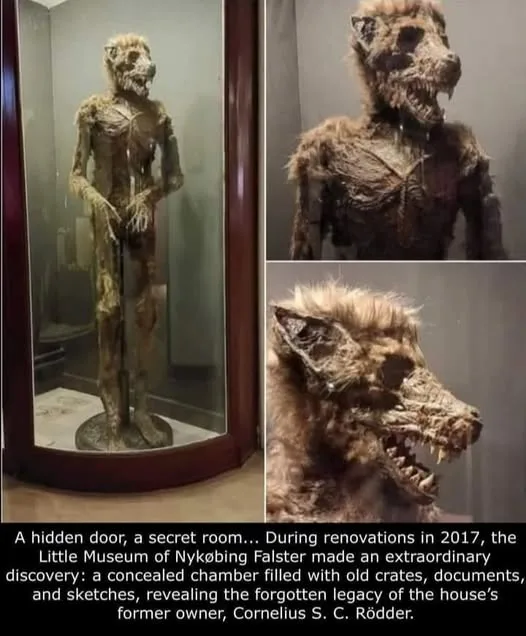
Among the museum’s most unsettling exhibits is Homo lupus, commonly referred to as the werewolf.
Taxonomic Classification (Disputed)
- Kingdom: Animalia
- Order: Primates
- Genus: Homo
- Species: Homo lupus
Rödder and Merrylin theorized that Homo lupus represents a divergent hominid species closely related to Homo sapiens and Homo vampyrus. Unlike folkloric interpretations of werewolves as cursed humans, Homo lupus was classified as a distinct biological species, capable of bipedal locomotion, tool use, and limited speech.
Physiological Characteristics
- Digitigrade lower limbs with reinforced calcaneal structure
- Dense keratinized hair growth across torso and limbs
- Extended canines and reinforced jaw musculature
- Enlarged olfactory bulbs, suggesting heightened scent perception
- Viral markers present in preserved tissue samples
The wolf-like features were hypothesized to originate from a viral-induced genetic mutation, possibly airborne, capable of activating dormant traits under environmental or hormonal stress.
The Preserved Specimen
The specimen displayed at the Museum Obscurum is believed to be:
- Female
- Approximately 15 years old
- Cause of death: Starvation
Skeletal analysis shows signs of prolonged malnutrition, fractured ribs, and worn teeth, suggesting a life spent in isolation. The hands retain semi-opposable thumbs, reinforcing theories of tool manipulation and cultural behavior.
This individual was reportedly recovered in Eastern Europe and represents the final collection of anthropologist Edward Harrell, a close associate of Merrylin. Harrell vanished shortly after transporting the specimen, fueling speculation that knowledge of Homo lupus was actively suppressed.
Between Myth and Science
Rödder insisted that creatures such as werewolves, vampires, fairies, and little dragons were not myths, but misunderstood biological realities, reframed by folklore after systematic denial by institutional science. The Museum Obscurum was designed as a challenge to accepted history—an archive of what humanity chose to forget.
“Monsters,” Rödder wrote, “are merely names given to truths that arrive too early.”
Today, the Museum Obscurum stands as a fictional yet haunting reminder of a world where the boundaries between science, myth, and fear are dangerously thin.