The universe and our planet operate on scales that defy everyday intuition, where vast emptiness contrasts with astonishing density. Two mind-bending comparisons capture this duality: there are more stars in the observable universe than grains of sand on all Earth’s beaches, yet a single grain of sand contains more atoms than there are stars in the cosmos. These facts highlight the immense scale of space against the compactness of matter. Deserts, covering one-third of Earth’s land, feature iconic dunes that occupy only 10–20% of their area, with most being rocky, mountainous, or ice-covered like Antarctica. This article explores these scales, blending astronomy, geology, and the poetry of perspective.
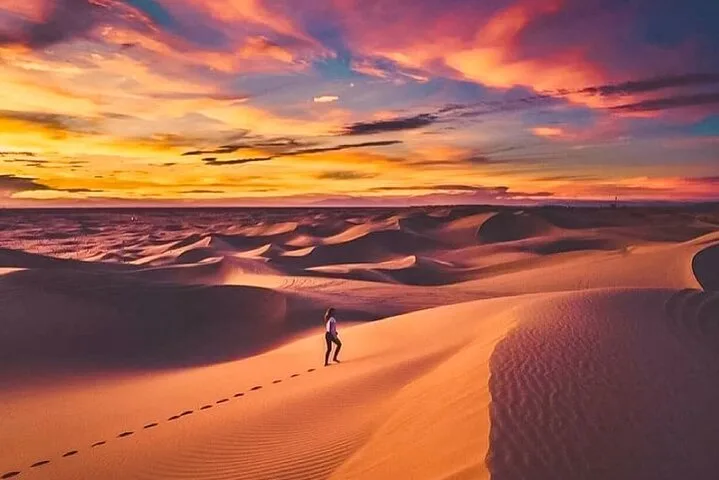
The Cosmic Scale: More Stars Than Sand
The observable universe spans 93 billion light-years in diameter, containing an estimated 2 trillion galaxies. Each galaxy averages 100–400 billion stars, yielding 10²² to 10²⁴ stars (100 sextillion to 1 septillion).
Earth’s beaches and deserts hold roughly 7.5 × 10¹⁸ grains of sand (quintillions), per University of Hawaii calculations. Stars outnumber sand grains by 10 to 1,000 times, emphasizing cosmic vastness.
This comparison, popularized by Carl Sagan, illustrates the universe’s scale: light from distant stars takes billions of years to reach us, while sand grains are tangible.
The Atomic Scale: More Atoms in a Grain Than Stars
A typical sand grain (0.5 mm diameter, silicon dioxide) contains 10¹⁸ to 10¹⁹ atoms. This exceeds observable stars (~10²² total), showing matter’s density.
Zooming in:
- Atom: ~10⁻¹⁰ meters.
- Nucleus: ~10⁻¹⁵ meters (femto-scale).
Quantum forces pack atoms tightly, contrasting cosmic voids where galaxies are separated by millions of light-years.
Earth’s Deserts: Arid Expanses and Dunes
Deserts cover 33% of land (~50 million km²), defined by <250 mm annual precipitation. They span every continent, including Antarctica’s cold deserts.
Yet, sand dunes form only 10–20% of deserts. Most are:
- Rocky plateaus (e.g., Sahara’s hamadas).
- Mountainous (e.g., Gobi’s ranges).
- Gravel plains (e.g., Australia’s gibber plains).
- Ice-covered (Antarctica).
The Sahara, largest hot desert (9 million km²), features iconic dunes but is mostly rock.
A Humbling Perspective
These scales reveal duality: cosmic vastness (stars > sand) versus microscopic density (atoms in sand > stars). Deserts, Earth’s arid third, mirror this with sparse dunes amid vast rock.
Like the Moors’ Alhambra precision or dendrochronology’s rings, they inspire awe at nature’s extremes—from infinite space to infinitesimal matter.
Next time you hold a grain of sand, remember: it contains a universe of atoms, while the night sky holds more stars than all Earth’s sands combined.
The cosmos and our world: infinitely large, infinitely small—and infinitely wondrous.