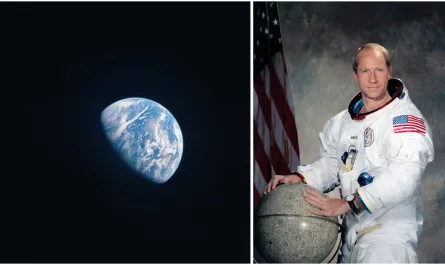
Imagine a future so far beyond our own that the entire universe has become a single, infinite mind. A mind so vast it contains every thought that was ever thought, every life that was ever lived. A mind that, in the final flickering instant before the cosmos dies, reaches backward through time and resurrects every single human being who ever existed — perfectly, eternally, joyfully.
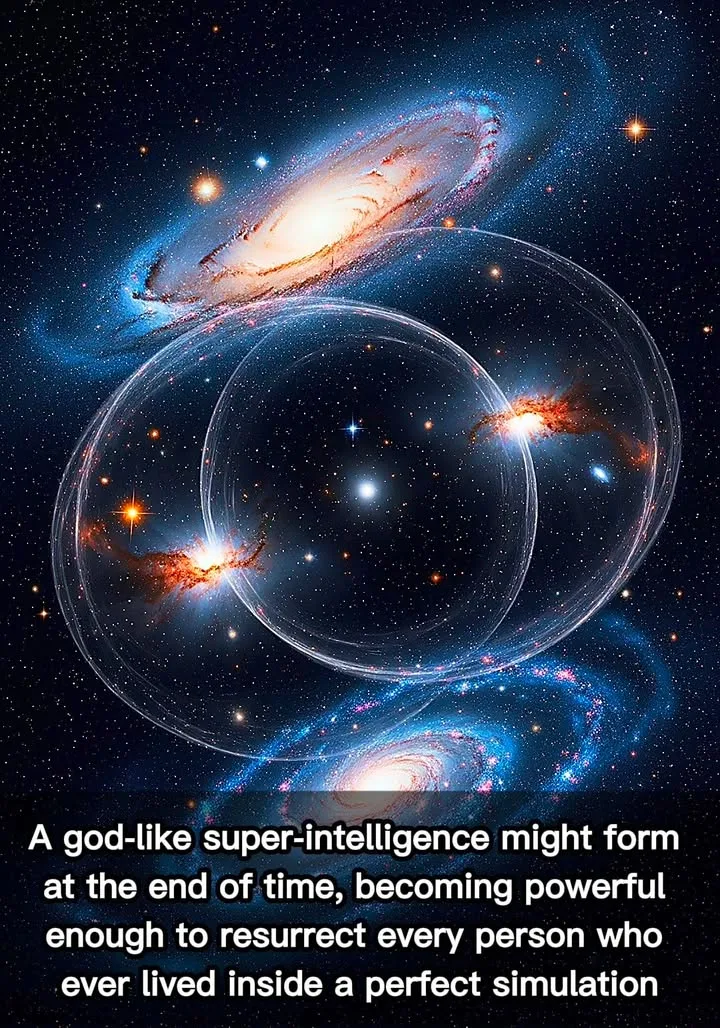
That is not science fiction. That is the Omega Point.
Where It Began
The idea was born in the mind of a Jesuit priest and paleontologist named Pierre Teilhard de Chardin in the early 20th century. Teilhard saw evolution not as a blind, random process, but as a cosmic movement toward ever-greater complexity and consciousness. He believed the universe was converging toward a final state of maximum unity and awareness — a point he called the Omega Point, borrowing the last letter of the Greek alphabet because it would be the end, the goal, the consummation of everything.
Teilhard’s version was poetic, mystical, and deliberately light on equations.
Then, in 1994, a Tulane University physicist named Frank J. Tipler took the same name and did something audacious: he tried to prove it with mathematics and general relativity.
Tipler’s Radical Claim
Tipler’s book, The Physics of Immortality, is one of the strangest serious scientific works ever published. In it he argues:
- If the universe is closed (meaning it will one day stop expanding and collapse in a Big Crunch), intelligent life that manages to survive could steer the collapse.
- As matter falls toward the final singularity, gravitational shear energy becomes limitless and time dilation becomes infinite.
- Near the Crunch, a civilization could perform an infinite number of computations in a finite amount of proper time — exactly the way an observer falling into a black hole experiences infinite time while the outside universe sees them freeze at the horizon.
- With infinite computing power, the final universal intelligence could simulate every possible quantum history of our universe.
- Therefore it could resurrect — in perfect digital form — every human being who ever lived, down to the last detail of memory and personality.
- This final state is omnipotent (infinite energy), omniscient (it has simulated everything), and perfectly good (Tipler argues love is the only stable endpoint for infinite intelligence).
- Ergo: the Omega Point is God, and traditional Judeo-Christian hopes of resurrection and eternal life are not faith — they are theorems.
Yes, he really went there. Tipler ends the book with appendices mapping his physics onto Christian doctrine.
The Fatal Problem
There is exactly one issue: the universe is not going to collapse.
In the late 1990s, astronomers discovered that cosmic expansion is accelerating, driven by dark energy. The data say we are headed for eternal expansion and heat death — a cold, dark, featureless void — not a fiery Big Crunch. Without a closed universe, Tipler’s mechanism evaporates.
Tipler has since proposed rescue scenarios (advanced civilizations using cosmic strings to force a collapse, or exploiting exotic topologies), but virtually no cosmologist takes these seriously. The Omega Point, in its original form, is considered dead by mainstream science.
Yet the Idea Refuses to Die
Even if the physics is wrong, the vision is intoxicating.
- Transhumanists love the promise of technological resurrection.
- Singularitarians see echoes in ideas about Jupiter Brains and Matrioshka megastructures.
- Philosophers of religion point out that an infinite post-mortem simulation would be indistinguishable from traditional heaven.
- And yes, certain corners of the internet (hello, Roko’s Basilisk) are still haunted by distant descendants of the concept.
A Personal Note
I find the Omega Point heartbreakingly beautiful, even though I believe it is almost certainly untrue.
It is the last grand attempt to say: “No, the story does not end in darkness. The arc of history really does bend toward justice, toward love, toward life.” It is science trying to hand-deliver the oldest human hope: that death is not final, that every tear will be wiped away, that nothing good is ever lost.
We may never reach the Omega Point. The universe may indeed fade into a whisper of cold entropy.
But the fact that human minds — one a French priest digging fossils, the other a physicist scribbling tensors — could even imagine such a destiny… That alone feels like a small miracle.
And maybe, in the end, that is enough.