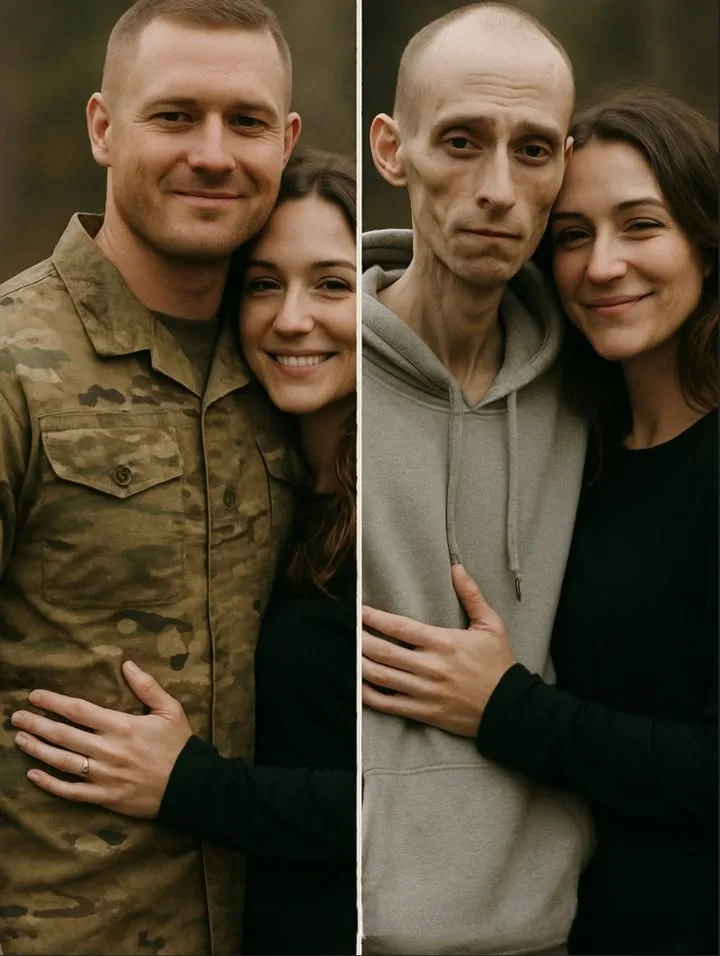
On the left, a photograph from 1944: a soldier stands tall—broad shoulders, steady eyes—his fiancée leaning against him with love and certainty.
On the right, the same man eleven months later: hollowed to skin and bone, eyes vacant, uniform hanging like a shroud. Captivity had stolen his body, his voice, his light. She still held him, but now her arms clung to fragility instead of strength.
“There was no sky there,” he whispered. Only darkness, beatings, and nights on freezing concrete. He didn’t count days. He counted shadows.
He came home, but not fully. The war followed him inside—into the silence of their house, into the trembling of his hands, into the mirror that reflected not a man, but a prisoner still trapped.
When she reached for him, he turned away.
“Don’t come in,” he said softly. “I’m still there.”
Because some wars don’t end with peace. They go on in the heart, in the home, in the quiet suffering no one sees.
The Story Behind the Photographs
The soldier was Private First Class James “Jimmy” O’Connell, 22, of the U.S. Army’s 106th Infantry Division, captured during the Battle of the Bulge on December 19, 1944. One of 23,000 Americans taken prisoner in that brutal winter offensive, Jimmy spent eleven months in Stalag IX-B near Bad Orb, Germany—one of the worst POW camps of the Western Front.
Conditions were hellish:
- Starvation rations (sometimes 600 calories a day).
- Forced labor in sub-zero quarries.
- Typhus, dysentery, and frostbite.
- Daily beatings and executions for minor infractions.
By liberation on April 2, 1945, Jimmy weighed 87 pounds—down from 165. Of the 6,000 men in his camp, nearly 1 in 4 did not survive.
The Homecoming That Wasn’t
His fiancée, Margaret “Maggie” Sullivan, waited through every uncertain month, writing letters that were never answered. When he stepped off the train in Boston, she barely recognized the man she loved. The embrace in the second photograph—taken by a local newspaper—was meant to be triumphant. Instead, it became a portrait of survival’s cruel cost.
Jimmy spoke little of the camp. Nightmares woke him screaming. Loud noises sent him diving for cover. He couldn’t bear to be touched, even by Maggie. Doctors called it “battle fatigue.” Today, we would call it complex PTSD.
He lived another 38 years, dying in 1983 at age 61. Maggie never left his side, though he often warned her, “Don’t come in—I’m still there.”
A Universal Wound
Jimmy’s story is one of thousands. Between 1941 and 1945, over 90,000 American POWs were held by Germany and Japan. Many returned physically alive but psychologically shattered. The U.S. military was slow to recognize PTSD—formal diagnosis only came in 1980—and veterans like Jimmy were often told to “tough it out.”
Their silent suffering shaped families for generations, much like the hidden lithopedion or the unspoken grief of Reyna Marroquín’s mother.
Lessons We Still Carry
- Trauma doesn’t end at the border. It follows soldiers home.
- Love can endure even when the person you loved seems lost.
- Some wounds are invisible—and no less real.
A Final Whisper
Jimmy O’Connell came home in body, but part of him remained in that frozen camp forever.
Like the father cradling his child in 1918’s influenza casket,
like Manfred Fritz Bajorat drifting alone at sea,
like the soldier’s hug in Normandy that saved a girl but couldn’t save himself—
some stories don’t end with survival.
They end with the quiet courage of those who keep loving anyway.
Rest easy, Jimmy.
You’re not still there anymore.