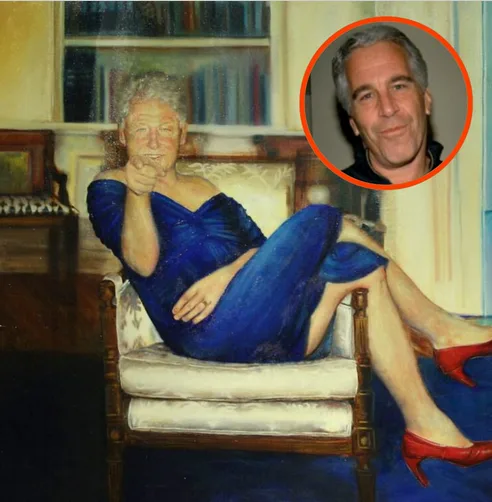
The viral image of former President Bill Clinton lounging in a blue dress and red heels—gesturing seductively from the Oval Office—has long fueled speculation, outrage, and dark humor. Discovered in Jeffrey Epstein’s Manhattan townhouse during a 2019 raid, the painting, titled Parsing Bill, hangs prominently in the entryway, a bizarre centerpiece amid Epstein’s macabre decor. Created by Australian-American artist Petrina Ryan-Kleid in 2012 as part of her master’s thesis at the New York Academy of Art, the work was intended as political satire, riffing on the Monica Lewinsky scandal and media portrayals of power. But its placement in Epstein’s home—a convicted sex trafficker with ties to Clinton—transforms it from jest to enigma. Why did Epstein display it? Was it a trophy, a taunt, or a twisted inside joke? As of December 02, 2025, with Epstein’s files partially unsealed, the painting remains a lightning rod, symbolizing the blurred lines between art, influence, and infamy.

The Painting: Satire Born of Scandal
Parsing Bill measures 40 x 40 inches on canvas, showing Clinton reclining on a blue chair in the Oval Office, legs crossed in red stilettos, a blue cocktail dress hiked up suggestively, and one hand beckoning the viewer. Ryan-Kleid, then 28, created it alongside War Games (George W. Bush playing with toy airplanes) for her thesis, Parsing the Presidency, critiquing how media and culture caricature leaders. The blue dress nods to Lewinsky’s infamous garment, stained during her affair with Clinton in 1998, which became tabloid fodder and impeachment evidence. “It was just a silly school artwork that was supposed to show, pictorially, the messages we are bombarded with in regards to these presidents,” Ryan-Kleid told Artnet News in 2019.
Sold at the 2012 Tribeca Ball fundraiser for $1,500 to an anonymous buyer (later identified as Epstein), Ryan-Kleid was stunned by its resurfacing. “I was absolutely stunned to find out that Epstein bought her painting during a major event at the school,” said model Christophe Nayel, who posed as Clinton. Prints are still available on Saatchi Art for $1,200–$2,000, but the original’s fate is unknown post-Epstein’s 2019 death.
Epstein’s Townhouse: A Gallery of the Grotesque
Epstein’s 7-story Upper East Side mansion at 9 East 71st Street was a lair of the macabre. The Clinton painting hung in the entryway, visible to all guests—including Clinton, who visited multiple times per flight logs. Other decor included:
Framed eyeballs in the foyer.
A human-sized chessboard with animal heads as pieces.
A stuffed poodle.
A doll swinging from a chandelier.
Reported by Vicky Ward in a 2003 Vanity Fair piece and confirmed in 2019 raids, the collection reflected Epstein’s obsession with power and provocation. The Clinton image, with its Lewinsky reference, fits this pattern—perhaps a jab at a powerful friend or a trophy of influence.
The Artist’s Perspective: Satire, Not Scandal
Ryan-Kleid, now a private painting teacher in New York, insists the work was apolitical. “Since I’m Australian, I wasn’t then, nor am I now, partisan about American politics,” she said. “At the time, most of my ideas were fresh from the Daily Show or Australian cable TV.” The dress references Lewinsky’s, but also Hillary Clinton’s 2009 Kennedy Center Honors gown—layering scandal with irony. She learned of Epstein’s ownership via family in 2019 and felt “bad about the content,” regretting its dark context.
Conspiracy Theories: From Meme to Madness
The painting’s 2019 reveal exploded online, spawning theories:
Clinton’s Involvement: Some claim it symbolizes Epstein’s “hold” over Clinton, tying to flight logs showing 26 trips.
False Flag: Fringe sites allege it’s AI-generated or planted to smear Democrats.
Power Dynamics: Epstein, with ties to elites, displayed it as a “trophy” of secrets.
Snopes rated the painting’s existence True but Epstein’s ownership Unproven, based on 2019 Daily Mail reports citing anonymous sources. No photos confirm it in the home, and unsealed files (2024) mention no such item. Yet, the image’s authenticity is undisputed—Ryan-Kleid’s Saatchi listings verify it.
Cultural Impact: Art as Mirror
The painting embodies Epstein’s world: satire twisted into scandal, art as power play. Ryan-Kleid’s thesis critiqued media caricature; Epstein’s display turned it sinister. It parallels the De Loys ape hoax—innocent intent corrupted by context—and echoes the Moors’ cultural fusion, where symbols shift meaning.
Lessons for Today
Art’s Power: Satire can expose or exploit, urging creators to consider legacy.
Misinformation: Like the Eltanin Antenna, unverified claims spread fast—verify sources.
Influence’s Shadow: Epstein’s decor reminds us of unchecked power’s grotesque side.
A Dress of Secrets
Parsing Bill, Epstein’s provocative display, was Ryan-Kleid’s satirical jab at Clinton’s scandals. Its presence in his home fuels endless speculation, a meme-born mystery. Like the white auroras’ rarity, it captivates—but truth lies in the artist’s intent, not the financier’s shadow. Art as satire, not symbol.