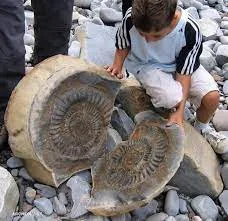
Along the dramatic limestone cliffs and tidal flats of England’s Jurassic Coast—a 95-mile stretch of Dorset and East Devon coastline designated a UNESCO World Heritage Site—lie some of the most spectacular fossilized ammonites on Earth. These massive, perfectly preserved spiral shells, dating to the Early Jurassic period around 180 million years ago, are the ancient remains of extinct marine mollusks that once dominated prehistoric oceans. Related to modern squid, octopuses, and nautiluses, ammonites thrived for over 300 million years before vanishing alongside the dinosaurs 66 million years ago. Their ribbed, chambered shells—now transformed into stone—offer a tangible link to a lost world, showcasing nature’s mathematical elegance and the relentless march of deep time.
Ammonites: Masters of the Mesozoic Seas
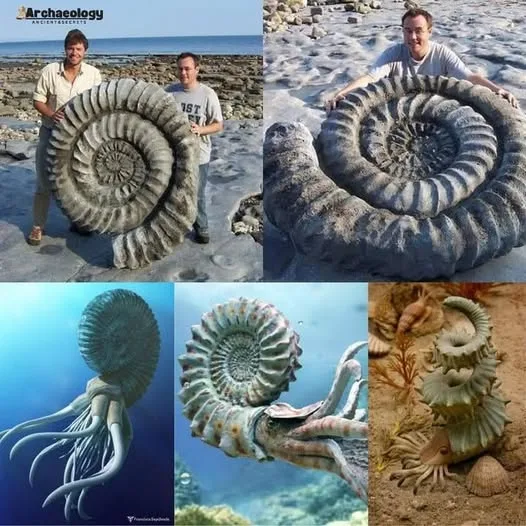
Ammonites were cephalopod mollusks with coiled, chambered shells that provided buoyancy and protection. Their name derives from the Egyptian god Ammon, whose ram horns resembled the creatures’ spirals. Ranging from a few centimeters to over 2 meters in diameter (with the Jurassic Coast yielding some of the largest), they were active swimmers and predators, using jet propulsion and tentacles to hunt smaller marine life.
Key features preserved in fossils:
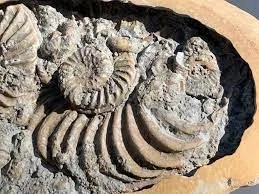
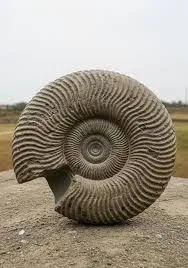
Ribbed shells for structural strength.
Septa and sutures – complex, wavy walls between chambers, unique to each species.
Siphuncle – a tube regulating gas for buoyancy.
These marine invertebrates ruled the oceans from the Devonian to the end-Cretaceous extinction, evolving rapidly and leaving a rich fossil record that serves as index fossils for dating rock layers.
The Jurassic Coast: A Fossil Treasure Trove
Stretching from Exmouth to Studland Bay, the Jurassic Coast exposes 185 million years of Earth’s history in its cliffs, from Triassic deserts to Cretaceous seas. The ammonite-rich layers belong to the Lower Lias (Early Jurassic, ~200–180 Ma), where blue-grey limestone and shale preserve marine life in exquisite detail.
Notable locations:
Lyme Regis – “Ammonite Capital,” famous for Mary Anning’s discoveries.
Charmouth – “Ammonite Pavement” with thousands of fossils in tidal flats.
Monmouth Beach – the “Ammonite Graveyard,” where large specimens litter the shore.
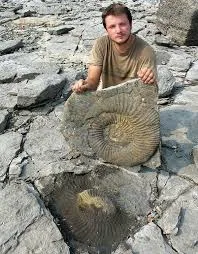
The largest Jurassic Coast ammonites, such as Asteroceras or Coroniceras, can exceed 1 meter in diameter, their weight and size making them prized finds.
Preservation and Geological Context
Ammonites fossilized when their empty shells sank to the seafloor after death, rapidly buried in oxygen-poor mud that prevented decay. Mineral-rich groundwater replaced organic material with pyrite (early stage) or calcite, turning shells to stone. The Jurassic Coast’s frequent landslides and erosion continuously expose new specimens, making it one of the world’s premier sites for amateur and professional paleontologists.
Cultural and Scientific Significance
These ammonites are more than rocks—they’re time capsules. Their intricate sutures helped scientists understand cephalopod evolution, while their abundance aided in correlating Jurassic strata globally. Locally, they’ve inspired folklore: known as “snake stones” or “St. Hilda’s serpents” in Whitby, with legends claiming saints turned serpents to stone.
The Jurassic Coast, designated UNESCO in 2001, attracts over 1 million fossil hunters yearly. Museums like the Lyme Regis Museum and Charmouth Heritage Coast Centre display giant specimens, educating visitors on Earth’s 4.6-billion-year story.
Lessons for Today
The ammonites teach:
Impermanence: A dominant group for 300 million years, gone in an instant.
Natural Beauty: Their spirals follow the golden ratio, inspiring art and mathematics.
Preservation Urgency: Climate-driven erosion threatens sites, urging protection.
A Spiral Through Time
The massive ammonites of England’s Jurassic Coast, frozen in stone 180 million years ago, are silent witnesses to a vanished ocean. Like the precision of Hot Wheels or the mystery of the Eltanin Antenna, they connect us to deep time—reminding us that today’s shores were once a thriving prehistoric sea. Step onto the beach at Lyme Regis, and you walk among giants turned to stone. 🐚